Monday, May 18, 2015

Intelligence: The ability to learn from experience, solve problems, and use knowledge to adapt to new situations
Is socially constructed thus... Can be culturally specific
Is intelligence one thing or several different abilities?
To find out sciwntists use Factor Analysis: A statistical procedure that identifies clusters of related items on a test
Charles Spearman used F A to discovery his g or (general intelligence)
Multiple Intelligences: Howard Gardber disagreed with Spearman's g and instead came up with the concept of multiple intelligences
He cane up with the idea by studying savants (a condition where a person has limited ability but is exceptional in one area)
Gardners Multiple Intelligences:
Visual/Spatial
Verbal/Lunguistic
Logical/Mathematical
Bodily/Kinesrheric
Musical/Rhythmic
Interpersonal
Intrapersonal
Natural
Sternberg three aspects of intelligence
Gardner Simplified
Analytical (acqdemic problem solving)
Creative (generating novel ideas)
Practical (required for everydayvtasks where multiplensolutions exist)
Emotional Intelligence
First called social intelligence
The ability to perceive express understand and regulate emotions
some studies show EQ to be a great future success and I Q
Brain size intelligence is there a link?
Small +.15 correlation between size intelligent scores (relative to body size)
we found .44 correlation with brain size and IQ score
Brain Function and Intelligence
Higher performing brains use less acrive than lower performjng brains (use less glucose)
Neurological speed is also a bit quicker
How do we Assess intelligence?
Alfred Binet and Theodore Simon set out to figure out The concept called a mental age (what a person a particular age should know)
They discovered that by discovering someones mental age they can predict future performance
Hoped they could use test to help children, not label them
Modern Tests of Mental Abilities
Weshsler Adult Intelligence Scale (WAIS) consists of 11 subtests and cues us in to strengths by using factor analysis
Aptitude v. Achievement tests
Aptitude: A test designed to predict a persons future perfornance
The ability for that person to learn
Achievement: A test designed to assess what a persob has learned
How do we construct Intelligence tests?
Teats must be Standaridized, Reliable, Valid
Standardization: The test must be pretested to a representatuve sample of people and form a normal distributation or bell curve
Flynn Effect: Intelligence test performance has been rising
Relaibaility: The extent which a test yields consistent results over time
Split halves or test restest method
Valadity: The extent to which is a text to measure what it is supposed to measure
Content Validity:  does the test sample at behavior of interest
Does Intelligence Change by time?
By age 3; a childs IQ can predict adolescent IQ scores
Depends in the type of intelligence, crystallized or fluid
Extrenes of Intelligence
Grouo differences in intelligenxe test scores
The bell curve is different for whites v. black
math scores are dufferent across genders and the highest scores are for the asian males
Why? nature or nature
Test bias?
Tests do discriminate but some argue that there sole purpose is to discriminate.
We have to look at the type of discrimination
Thinking
prototypes:or best example of a category
if he knew object is similar to our prototype we are better able to recognize it
Algorithms: a methodical, logical rule or procedure that guarantees solving a particular problem
Wgat are the benefits and dentrimebts of algorithms?
obstacles to problem-solving
Match problem
fixation:  The inability to see a problem from a new perspective
Mebtal Set:
A tendency to approach a problem in a particular way especially if it has worked in the past
may or may not be a good thing
Types of Heyristics
overconfidence: The tendency to be more confident than correct overestimate the accuracy of your beliefs and judgments
cognition: another term for thinking knowing and remembering
maybe by studying the way we think we can eventually think better
how to resolve problems?
heuristica:  role of thumb strategy that often allows us to make judgments and solve problems efficiently
shortcut that could be prone to errors



State of the mind
Sleep
- Is a state of consciousness
- We are less aware of our surroundings


Conscious –subconscious –unconscious


Daydream vs fantasies (both able to control it )


Why do we daydream

- Help prepare for future events

- They can nourish our social development

- Can substitute for impulsive behavior

Biological rhythms
- Annual cycles: seasonal variations(bears hibernation, seasonal affective disorder)
- 28 day cycles: menstrual cycle
- 24 hour cycle: our circadian rhythm
- 90 minutes cycle : sleep cycles

Circadian rhythm
- our 24 hour biological clock
- Our body temperature and awareness changes throughout the day
- It is best to take a test or study during your circadian peaks

Sleep stages
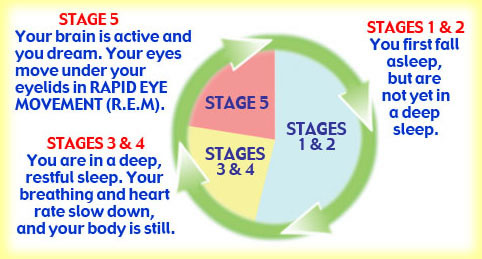
- There are 5 identified stages of sleep
- It takes about 90-100 minutes to pass through the 5 stages
- The brain’s waves will change according to the sleep stage you are in
- The first four stages are known as NREM sleep
- The fifth stage is called the ReM sleep


Language
Our spoken written or gestured words and the way we combining them in communication


Phonemes
In a spoken language, the smallest distinctive sound unit.

Morphemes
In a language, the smallest unit that carries meaning
Can be a word or part of a word ( prefix or suffix)


Grammar
A system of rules in a language that enables us to communicate and understand others

Semantics
The set of rules by which we derive meaning in a language
Adding Ed at the end of the words means past tense

Syntax
The rules for combining words into grammatically sensible sentences.

Language development
Babbling stage: starting at 3-4 months, the infant makes spontaneous sounds. Not limited to the phonemes of the infant’s household language.

One word stage: 1-2 years old, uses one word to communicate big meanings

Two word stage: at age 2, uses two words to communicate meanings- called telegraphic speech.


Skinner
Skinner thought that we can explain language development through social learning theory.


Chomsky
In born universal grammar
We acquire language too quickly for it to be learned.
We have this “learning box” inside our heads that enable us to learn any human language.

Whorf’s linguistic relativity
The idea that Language determines the way we think( not give versa)

Thinking without language
We can think in words
But more often we think in mental pictures.


Kohler’s chimpanzees


5/12/15
Stage 1
- Kind of awake and kind of asleep
- Only lasts a few minutes, and you usually only experience it once a night
- Eye begins to roll slightly
- Your brain produces theta waves( high amplitude, low frequency slow)

Stage 2
- His follows stage 1 sleep is the “baseline” of sleep
- This stage is part of the 90 minute cycle and occupies approximately 45-60%. Of sleep
- More theta waves that get progressively slower
- Begin to show sleep spindles…short burst of rapid brain waves

Stage 3&4
- Slow wave sleep
- You produce delta waves
- If awoken you will be very groggy
- Vital for restoring body’s growth hormones and good overall health

Rem Sleep
- Rapid eye movement
- Often called paradoxical sleep
- Brain is very active
- Dreams usually occur in REM
- Body is essentially paralyzed
Stage 5
- Compose 20-25 % of a normal nights sleep
- Breathing,heart rate and brain wave activity quicken
- Vivd dreams can occur
- For rem, you go back to stage 2

Sunday, April 26, 2015

Unit 5

Intelligence: The ability to learn from experience, solve problems, and use knowledge to adapt to new situations
Is socially constructed thus... Can be culturally specific
Is intelligence one thing or several different abilities?
To find out sciwntists use Factor Analysis: A statistical procedure that identifies clusters of related items on a test

Charles Spearman used F A to discovery his g or (general intelligence)

Multiple Intelligences: Howard Gardber disagreed with Spearman's g and instead came up with the concept of multiple intelligences
He cane up with the idea by studying savants (a condition where a person has limited ability but is exceptional in one area)
Gardners Multiple Intelligences:
Visual/Spatial
Verbal/Lunguistic
Logical/Mathematical
Bodily/Kinesrheric
Musical/Rhythmic
Interpersonal
Intrapersonal
Natural
Sternberg three aspects of intelligence
Gardner Simplified
Analytical (acqdemic problem solving)
Creative (generating novel ideas)
Practical (required for everydayvtasks where multiplensolutions exist)
Emotional Intelligence
First called social intelligence
The ability to perceive express understand and regulate emotions
some studies show EQ to be a great future success and I Q
Brain size intelligence is there a link?
Small +.15 correlation between size intelligent scores (relative to body size)
we found .44 correlation with brain size and IQ score
Brain Function and Intelligence
Higher performing brains use less acrive than lower performjng brains (use less glucose)
Neurological speed is also a bit quicker

How do we Assess intelligence?
Alfred Binet and Theodore Simon set out to figure out The concept called a mental age (what a person a particular age should know)
They discovered that by discovering someones mental age they can predict future performance
Hoped they could use test to help children, not label them
Modern Tests of Mental Abilities
Weshsler Adult Intelligence Scale (WAIS) consists of 11 subtests and cues us in to strengths by using factor analysis

Aptitude v. Achievement tests
Aptitude: A test designed to predict a persons future perfornance
The ability for that person to learn
Achievement: A test designed to assess what a persob has learned
How do we construct Intelligence tests?
Teats must be Standaridized, Reliable, Valid
Standardization: The test must be pretested to a representatuve sample of people and form a normal distributation or bell curve
Flynn Effect: Intelligence test performance has been rising
Relaibaility: The extent which a test yields consistent results over time
Split halves or test restest method
Valadity: The extent to which is a text to measure what it is supposed to measure
Content Validity:  does the test sample at behavior of interest
Does Intelligence Change by time?
By age 3; a childs IQ can predict adolescent IQ scores
Depends in the type of intelligence, crystallized or fluid
Extrenes of Intelligence
Grouo differences in intelligenxe test scores
The bell curve is different for whites v. black
math scores are dufferent across genders and the highest scores are for the asian males
Why? nature or nature
Test bias?
Tests do discriminate but some argue that there sole purpose is to discriminate.
We have to look at the type of discrimination
Thinking
prototypes:or best example of a category
if he knew object is similar to our prototype we are better able to recognize it
Algorithms: a methodical, logical rule or procedure that guarantees solving a particular problem
Wgat are the benefits and dentrimebts of algorithms?
obstacles to problem-solving
Match problem
fixation:  The inability to see a problem from a new perspective
Mebtal Set:
A tendency to approach a problem in a particular way especially if it has worked in the past
may or may not be a good thing
Types of Heyristics
overconfidence: The tendency to be more confident than correct overestimate the accuracy of your beliefs and judgments
cognition: another term for thinking knowing and remembering
maybe by studying the way we think we can eventually think better
how to resolve problems?
heuristica:  role of thumb strategy that often allows us to make judgments and solve problems efficiently
shortcut that could be prone to errors

Unit 5

Language
Our spoken written or gestured words and the way we combining them in communication


Phonemes
In a spoken language, the smallest distinctive sound unit.

Morphemes
In a language, the smallest unit that carries meaning
Can be a word or part of a word ( prefix or suffix)


Grammar
A system of rules in a language that enables us to communicate and understand others

Semantics
The set of rules by which we derive meaning in a language
Adding Ed at the end of the words means past tense

Syntax
The rules for combining words into grammatically sensible sentences.

Language development
Babbling stage: starting at 3-4 months, the infant makes spontaneous sounds. Not limited to the phonemes of the infant’s household language.

One word stage: 1-2 years old, uses one word to communicate big meanings

Two word stage: at age 2, uses two words to communicate meanings- called telegraphic speech.


Skinner
Skinner thought that we can explain language development through social learning theory.


Chomsky
In born universal grammar
We acquire language too quickly for it to be learned.
We have this “learning box” inside our heads that enable us to learn any human language.

Whorf’s linguistic relativity
The idea that Language determines the way we think( not give versa)

Thinking without language
We can think in words
But more often we think in mental pictures.


Kohler’s chimpanzees


Unit 5

            Perceptions
The process of organizing and interpreting information enabling

             Visual capture
The tendency for vision to dominate the other senses.

             Gestalt psychology
*Gestalt means"an organized whole"
These psychologists emphasize our tendency to integrate pieces of information into meaningful wholes.
The whole is the greater than the sum of its parts.

              Figure ground relationship
The organization of the visual field into objects (figures) that stand out from their surroundings (ground)

              Grouping
The perceptual tendency to organize stimuli into groups that we understand

          1.proximity we group by figures together
          2 similarity we group items that are similar
          3 continuity we are looking for continuous patterns
          4 connectedness that is uniform and link together

Ex: Look at a school or a classroom


             Depth perception
*The ability to see objects in three dimensions although the images that strike the retina are two dimensional.
*Allows us to judge distance.

              Visual cliff
A baby is crawling to the edge

           
How do we transform a two dimensional objects to a three dimensional
 Binocular cues: depth cues that depend on two eyes
    Monocular cues: depth cues that depend on one eye


                  Binocular cue
-Retinal disparity: a binocular cue for seeing depth
The closer an object comes  to you the greater the disparity is between the two Image

                    Monocular cues
-Interposition: if something is blocking our view we perceive it as closer
-Relative size: if we know that two objects are similar in size the one that looks smaller is farther away
-Relative clarity we assume hazy objects are farther away

                     More monocular cues
-Texture gradient : the coarser it looks the closer it is
-Relative height: things higher in our field of vision they look farther away
Relative motion: things that are closer appear to move more quickly
Linear perspective : parallel lines seen to converge with distance
Light and shadow dimmer objects appear farther away because they reflect less light

                       Phi phenomenon
An illusion of movement created when two or more adjacent lights blink on and off in succession
                      Perceptual consistency
Perceiving objects as unchanging even as illumination and retinal images changes

Tuesday, April 7, 2015

motor neurons


UNIT 4 CONT...


  • Nervous system 
    • central nervous system: the brain and spinal cord 
    • peripheral nervous system: all nerves that are not encased in bone. everything but the brain and spinal cord
          • SOMATIC: controls voluntary muscle movement. Uses motor neurons.
          • autonomic: controls the automatic functions of the body 
  • Sympathetic:fight or flight response. Automatically accelerates heart rate, breathing, dilates pupils, slows down digestion. 
  • parasympathetic: automatically slows the body down after a stressful event. Heart rate and breathing slow down pupils constrict and digestion speeds up.
  • reflexes: normally, sensory neurons take info up through spine to the brain, some reactions occur when sensory neurons reach just the spinal cord.
  • hormones

Unit 4


  • Nervous System-it starts with an individual nerve cell called neuron
  • how does a neuron fire?
    • resting potential: slightly negative charge 
    • reach the threshold when enough neuron-transmitters reach dendrites
    • go into action potential (firing)
  • The All or None Response: the idea that either the neuron fires or it does not not-no part way firing. 
    • ex. firing a gun
  • Types or Neurotransmitter
    • Acetlycholing (ACH): deals with motor movement and memory. Lack  of ACH has been linked to Alzheimer's disease
    • Dopamine: deals with motor movements and alertness. Lack of dopamine has been linked to  Parkinson's disease. Too much has been linked to schizophrenia.
    • Serotonin: involved in mood control. Lack of serotonin has been link to clinical depression
    • Endorphin: involved in pain control. Many of our most addictive drugs deal with endorphin.
  • Drugs can be...
    • agonist-make neuron  fire
    • antagonist: stop neural firing
    •   re-uptake inhibitors - block neurotransmitters from entering the neuron
    • Norepinephrine:  helps control alertness and arousal. An under supply can lead to depression. AN over supply can lead to manic symptoms.
    • GABA (gamma-aminobutytic acid):major inhibitory neurotransmitters. An under supply can lead to tremor.
    • Glutamate: major excitatiry neurotransmitter; involved in memory. Oversupply can overstimulate the brain leading to migraines(This is why some people avoid MSG in food)
  • Types Neurons
    • sensory neurons(afferent Neurons): take information from the senses to the brain
    • inter neurons: take messages from sensory neurons to other parts of the brain or to motor neurons.
    • motor neurons(efferent neurons): take information from the brain to the rest of the body.

Tuesday, March 3, 2015

Eating Disorders Documentary

eating disorder

Eating Disorder
*Bulimia Nervosa
-characterized by binging( Eating large amounts of food) and purging ( Getting rid of the food)
-Basically eating then purposing throwing it up.
* Anorexia Nervousa
-starve themselves to below 85% of their normal body weight
-see hemselves as fat
- vast majority are women
*obesity
-severly overweight to the point where it causes health issues
-mostly eating habits but some people are predisposed towards obesity

Monday, March 2, 2015

3/2/15

Motivation and Emotion 3/2/15
*What motivates you?
Ex: During the school days, at work, etc…
*Where do we begin?
·         Motivation- a psychological process that directs and maintains your behavior toward a goal.
·         Motives- are the needs, wants, interests, and desires that propel or drive people in certain directions.
*Motivation
·         Instinct theory: we are motivated by our inborn automated behaviors

*Biological and social motives
Biological motives- hunger, thirst, sex. Sleep excretory
Social motives- achievements order play autonomy affiliation

·         Drive theory- biological internal motivation (Homeostasis)
·         Incentive theory- environmental motivation (no as much homeostasis more outside factors
*drive reduction theory
- DRT when individuals experience a need or drive they’re motivated to reduce that need or drive
-therefore drive theories believe that the source of motivation lies within the person (not from the environment)
-need (e.g. for food, water)….Drive (hunger, thirst)……Drive-reducing behaviors (eating, drinking)
* Arousal theory
·         Arousal- level of alertness, wakefulness, and activation in the CNS
       -the optimal level of arousal varies with the person and the activity
·         Yerkes- Dodson law- we usually perform most activities best when we are moderately
·         Challenge- moderately low level
·         Easy- moderately high level
·         the law also states that we perform worse when arousal is either to low or too high
*Maslow’s Hierarchy need
*Biological Basis of hunger
-hunger doesn’t come from the stomach
-it comes from the brain
-what part of the brain?
-The hypothalamus

*motivation- hunger
·         Glucose
-the form of sugar that circulates in the blood
- provides the major source of energy for body tissues
-glucose low: hunger
-Glucose high: feel full
*Body chemistry
-glucose
-the hormone insulin coverts glucose to fat
- When glucose levels drop- hunger increase
*Hypothalamus
·         (Lateral Hypothalamus)
-When stimulated it makes you hungry
- When lesioned (Destroyed) you will never be hungry again
·         (Ventromedial Hypothalamus)
-when stimulated you feel full
-when lesioned you will never feel full again

*Hunger- environmental factors
- There are several environmental factors that affect our hunger
1. Availability of food
2. Learned preference ad habits
3. Stress

* Hunger continue
-eating for survival vs. eating for pleasure
-tasty food is more likely to be eaten even when full (Palatability)
-environmental cues matter
1. Commercials
2. Odors
3. Talking about it

*Learned preference and habits
-          Food preferences- acquired through learning
-          Sugary and fatty foods are important for survival ( that’s why they’re popular)

*SET POINT THEORY
-THE HYPOTHALAMUS ACTS LIKE A THERMOSTAT
-WANTS TO MAINTAIN A STABLE WEIGHT
ACTIVATE THE LATERAL WHEN YOU DIET AND ACTIVATE THE VENTROMEDIAL WHEN YOU START TO GAIN WEIGHT

*CULTURAL AND HUNGER


Thursday, February 26, 2015

2/26/15

Note 2/26/15
Ø  What makes compassion work?
-equity
-self disclosure
Ex Both are vacuuming
Ø  Altruism
-unselfish regard for the welfare of others
-bystander effect (bystanders less willing to help if there are other bystander around)
-Kitty Genovese case
Ø  Social Exchange Theory
-the idea that our social behavior is an exchange process, which we maximize the benefits and minimize the cost.

Ø  Peacemaking
-give people super ordinate (or share goal) that can only be achieve through cooperation.

-Grit conflict solution (Graduated and Reciprocal Initiatives in tension reduction)

Wednesday, February 25, 2015

notes 2/25/15

Notes 2/25/15

Ø  Scapegoat Theory
The theory that prejudice provides an outlet for anger by providing someone to blame.
Ø  Aggression
-Any physical or verbal behavior intended to hurt or destroy

Ø  The biology of aggression
-genetics
-neutral influences (is aggression in the brain)
-biochemical

Ø  The psychology of aggression
Frustration-aggression Principle
-the blocking of an attempt to achieve some goal
-creates anger which generates aggression

Goals can be sports or work, relationship, body condition, etc…

Ø  Conflict
-a perceived incompatibility of action, goals or ideas
- Situation where people must choose between an act that is beneficial to themselves but harmful to others and an act that is moderately beneficial to all.

-social trap or prisoner’s dilemma

Ø  Attraction 5 factors of attraction…
1.       Proximity
-          Repeated exposure to something breed liking.
-          Geographic nearness
-          Mere exposure effect
-          Ex: Taiwanese Letters
2.       Reciprocal Liking
-you are more likely to like someone who likes you.
-why?
-except in elementary school!!!!
3.       Similarity
-Paula Abdul was wrong-opposites do not attract
-birds of the same feather do flock together
-similarity breeds content
4.       Liking through association
5.       Physical Attractiveness
Ø  Love
-passion love: an aroused state of intense positive absorption of another

-compassionate love: the deep affectionate attachment we feel for those with whom our lives are intertwined. 

Monday, February 23, 2015

Group Influence on Behavior

*Social Facilitation*
  • Improved performance of tasks in the presence of others.
  • occurs with simple or well learned tasks
  • not with tasks that are difficult or not yet mastered
*Yerkes-Dodson Law*
  • There is an optional level of  for the best performance of any task easy task---relatively high 
  • difficult tasks---low arousal
  • other tasks---moderate level
*Social Loafing*
  • That tendency for people in a group to exert less effort when pooling efforts toward a common goal than if they were individually accountable. 
*Deindividuation* 
  • The loss of self awareness and self- restraint occurring in group situations that foster arousal and anonymity
*Group Polarization*
  • The concept that a group's attitude s one of extremes and rarely moderate
*Group think*
  • The mode of thinking that occurs hen the desire for harmony in a decision making group overrides common sense.
* Self- Fulfilling Prophecies
  • Occurs whenever a person's belief about others leads one to act in ways that induce the others to appear to confirm the belief.

Wednesday, February 18, 2015

Social Thinking: Crash Course Psychology #37

Social Psychology Notes 2/18/15

Social Psychology 
"The Study of how we think about, influence and relate to one another."

*Social Thinking*
(How do we think about one another?)

*Attribution Theory*

  • The idea that we give a casual explanation for someone's behavior.
  • We credit that behavior either to the situation or...
  • To the person's disposition
*Fundamental Attribution Error*
  • The tendency to underestimate the impact of a situation and overestimate the impact of person disposition.
-ex:How do you view your teacher behavior?You probably attribute it to their personality rather than their profession.

*Attitudes
  • A belief feeling that predisposes one to respond in  a particular way to something.
  • Does your attitudes guide our action?Only if...
-External pressure is minimal
-We're aware of our attitudes 
 The attitude is relevant to the behavior

*Foot-in-the-door phenomenon
  • The tendency for people who have first agreed t a small request to comply later with a larger request. 
*Door-in-face phenomenon
  • The tendency for people who say not to a huge request, to comply with a smaller one.
*Zimbardo Prison Study 
  • Role playing affects attitudes. What do you think happened when college students were made to take roles of prison guards and inmates.


Wednesday, February 11, 2015

Psychological Research - Crash Course Psychology #2

Research Method Notes

Research Method
1.    Hypothesis: expresses a relationship between two variables.
2.    Independent Variable: whatever is being manipulated in the experiment
3.    Dependent Variable: what ever is being measured in the experiment.
4.    Operational Definition: explain what you mean in your hypothesis. how will the variables be measured in "real life" terms.
5.    Hindsight Bias: the tendency to believe, after learning the outcome, that you knew all along.
6.    Overconfidence: we tend to think we know more than we do.
7.    The Barnum Effect: the tendency for people to accept very general or vague characterizations of themselves and take them to be accurate.
8.    Sampling: identify the population you want to study. The sample must be representative of the population you want to study.
9.    Experimental Method: looking to prove causal relationships. Cause = Effect
10. Confounding Variable: anything that could cause a change in B, that is not A.
11. Survey Method: most common type of study in psychology. Measure correlation. Cheap and fast. Need a good random sample.
12. Naturalistic Observation: watch subjects in their natural environment. Do not manipulate the environment.
13. Correlation Coefficient: a number that measures the strength of a relationship. Range is from -1 to +1. The relationship gets weaker the closer you get to zero.
14. Case Studies: a detailed picture of one or a few subjects. Tells us a great story...but is just descriptive research. Does not even give us correlation data.
15. Hawthorne Effect: just the fact that you know you are in an experiment can cause change.
16. Correlation Method: expresses a relationship between two variable. Does not show causation.
a.    Positive Correlation: the variables go in the SAME direction.
b.    Negative Correlation: the variables go in opposite direction.
17. Applied vs. Basic research
a.    Applied Research has clear, practical applications. YOU CAN USE IT!!!
b.    Basic Research expose questions that you may be curious about, but not intended to be immediately used.
18. Statistics: recording the results from out studies.
19. Mean(most common), median(average), mode(middle)
20. Descriptive Statistics: just describes set of data.
21. Other Measures of Variability
a.    Standard Deviation: the variance of scores around the mean.
b.    The higher the variance is, the more spread out the distribution is


Review Practice

Questions Review
1. What are the three measures of central tendency?
-mean,medium,mode
2. Out of the following numbers what is 3? 2 5 6 7 3 8 3 1
-  mode
3. which central measure of tendency also means average?
-mean
4. If I take the highest score and subtract the lowest score I am left with the ____?
-range
5. What is the mean of these scores? 10 3 2 4 6
-5
6.Between mean, medium and mode, which is most commonly used?
-mean
7. What measure is most affected by extreme scores?
- mean
8. If i test into the 90th percentile for height what does that mean?
- Higher than 90%
9. If i want to study the behavior of one individual what method am i most likely to use?
-case study
10. Which method manipulates factor to reveal the outcome?
-experimental
11. What method explores cause ad effect?
-experimental
12. I am told to research the behavior of monkeys. I decide to go to the zoo and watch them in their own habitat. This would be known as ____________.
-Naturalistic Observation
13. If I want to get the most accurate personal attitudes or opinions on a particular issue I can use the ___method.
-survey
14. All the people in whom i am taking my results from are known as the _______.
-sample


Thursday, January 29, 2015

Abnormal Psychology (A.K.A Psychological Disorders) Notes 1/20/15

1/20/15
Abnormal Psychology (A.K.A Psychological Disorders) 

**Def- A "harmful dysfunction in which behavior is judge to be a typical, disturbing, manipulative, and unjust.

  • Early theories
-Abnormal behavior was "evil spirits"
  • Perspective and Disorders
Psychology, school, perspective and causes of the disorder.
  • DSMIV
          - Diagnostic Statistical Manual of Mental Disorders: the big book of disorders
          -DSMIV will classify disorders and describe the symptoms.
          -DSMIV will not explain the causes or possible cures
  • 2 Major Classification in the DSM  
          1. Neurotic Disorders
                 -Distressing but one can still function in society and act rationally
          2. Psychotic Disorders
                 - Person loses control with reality, experiences distorted perceptions
  • Anxiety Disorders
- a group of conditions where the primary symptoms are anxiety of defenses against anxiety
- the patient fears something awful will happen to them
- they are in a state of intense apprehension, uneasiness, uncertainty, or fear.   
  • Phobia
-  a person experience sudden episodes of intense dread
- must be an irrational fear
  • General Anxiety Disorder( GAD)
    -A anxiety disorder in which a person is continuously tense, apprehensive and in a state of autonomic nervous system arousal.
          -The patient s constantly tense and worried, feels inadequate, is oversensitive, can't concentrate and suffers from insomnia.
  • Panic Disorder 
          - An anxiety disorder marked by a minute-long episode of intense dread in which a person experiences terror and accompanying chest pain, choking, and other frightening sensations.
  • Obsessive- Compulsive Disorder( OCD)  
- persistent unwanted thoughts(obsessions) cause someone to feel the need (Compulsive) to engage in a particular action.
-Obsession about dirt and germs may lead to compulsive hand washing
-Common OCD: washing, repeating, checking, touching
  • Post- Traumatic Stress Disorder( PTSD)
 -Flashbacks or nightmares following a person's involvement in of an extremely stressful events.
-Memories of the event cause anxiety
  • Somatoform Disorders
-Occurs when a person manifest a psychological problem through a physiological symptom
-2 Types
  1. Hypochondria 
- Has frequent physical complaints for which medical doctors are unable to locate the cause.
-They usually believe that the minor issues(headache, upset stomach)  are indicative are more severe illnesses.
    
    2.  Conversion Disorder
-Report the existence of severe physical problems with no biological reason
-like blindness or paralysis      

Introduction to Psychology Notes 1/8/15

1/8/15
Introduction to Psychology Notes 

  • Goals of psychology(5 Types)

  1.  Observe
  2.  Predict
  3.  Explain
  4.  Describe
  5.  Control


  • History of Psychology 
  1. Mind and body are connected

             - The Hebrews
             - Aristotle
             - Augustine
     2. Mind and body are distinct
             -Socrates
             -Plato
             -Descartes
     3. Same ideas are in born
            -Socrato
            -Plato
     4. The mind is a blank state
            -Aristotle
            -Locke

  • Edward Titchener ( Structuralism)
-Structuralism was the first school of psychology.
-Broke don mental processes into the most basic components.
(structures) of conscious experiences
-What did you see, hear, taste,smell, and feel?(Introspection)
-Based on this, how did you behave?

  • William James (Functionalism) 
-Focus less on the how of sensation and perception, but rather the why.
-Emphasized the process of how the thoughts formed, change, and how they adapted.

  • The Big 7
  1. Neuroscience Perspective
-Focus on the how the physical body and brain creates our emotions, memories, and sensor experiences.

    2.   Evolutionary Perspective
- Focus on Darwinism
-We behave the way we do because we inherited those behaviors
-Thus the behaviors must have helped ensure our ancestors survival

    3.   Psychodynamic Perspective
-Father by Sigmund Freud
- Our behavior comes from our unconscious drives
-Usually  stemming from our childhood

    4.   Behavioral Perspective
- Focus on our observable behavior
-Only cares about the behaviors that impair our living and attempts to change them.

    5.   Cognitive Perspective
- Focus on how we think(or encode information)
- How do we see the world?
-How do we learn to act to sad or happy events?
- Cognitive Therapists attempts to change the way you think.

    6.   Social- Cultural Perspective
-Focus on ho your cultural affects your behavior

    7.    Humanistic Perspective
- Focus on positive growth.
-Attempt to seek self-activation.
-Therapists use active listening and unconditional positive regard.